

Brine Discharge, ZLD and Mineral Recovery in Desalination
Seawater Desalination produces fresh water, but it also produces a concentrated stream known as brine. In a seawater reverse osmosis (SWRO) system, most of the dissolved salts remain in the concentrate because the RO membrane allows water to pass through while rejecting most dissolved ions.
Managing this concentrated stream is an important part of desalination system design.
For some coastal projects, controlled brine discharge through a properly designed marine outfall may be practical. Other projects may face stricter discharge requirements, limited receiving-water capacity, inland locations, or a need to recover more water. In these situations, additional treatment such as brine concentration, evaporation, crystallization, or Zero Liquid Discharge (ZLD) may be considered.
There is also growing interest in mineral recovery. Instead of treating concentrated brine only as a waste stream, some projects investigate whether selected salts or minerals can be recovered as useful products.
The right approach depends on seawater chemistry, plant capacity, recovery target, site conditions, environmental requirements, energy availability, and the economics of the project.
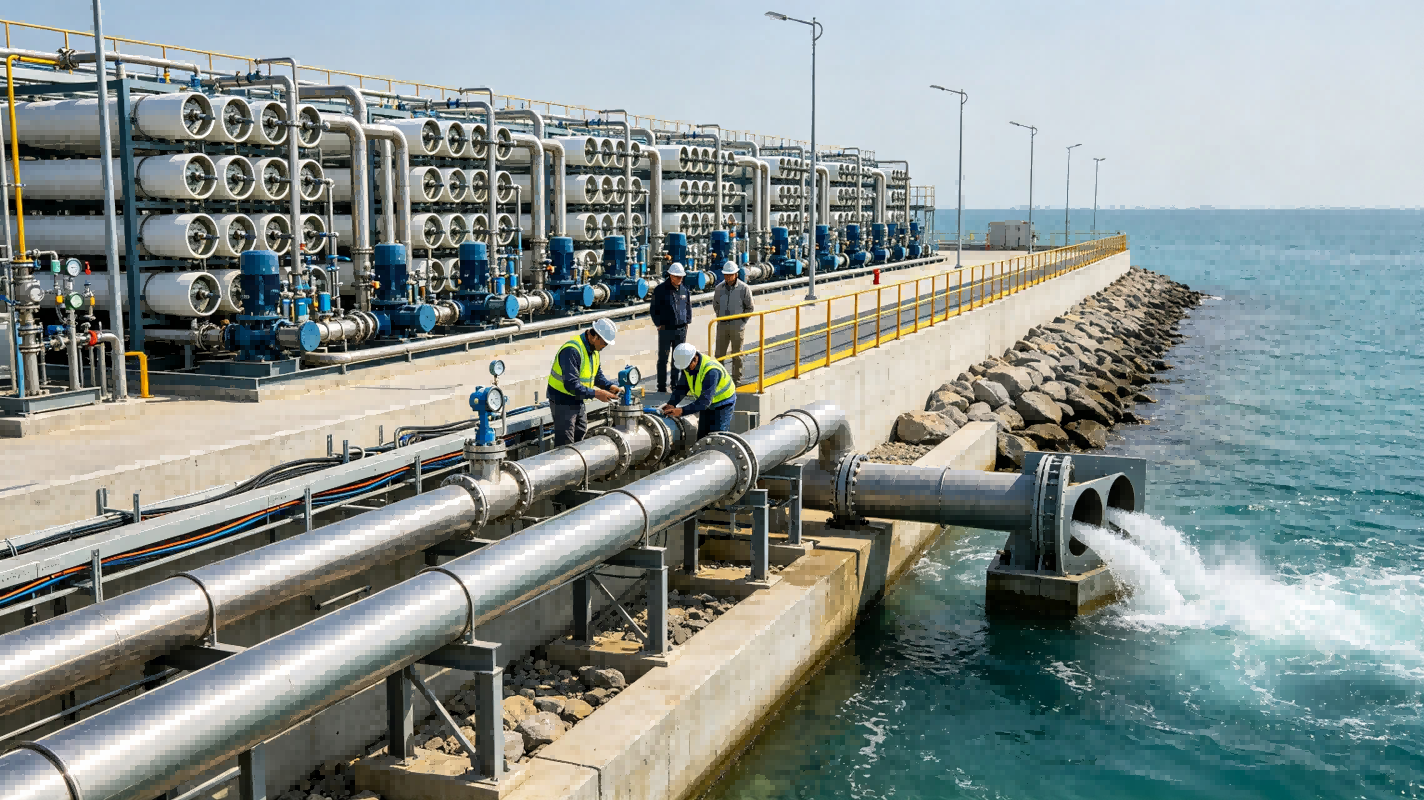
Brine is the concentrated liquid remaining after water has been removed from saline feedwater.
In an SWRO system, seawater is pressurized and sent through RO Membrane Elements. A portion of the water passes through the membrane as permeate, while most dissolved salts remain in the concentrate stream.
The resulting brine has a higher salt concentration than the original seawater.
A simplified process looks like this:
Seawater → Pretreatment → High-Pressure RO → Permeate + Concentrate
The permeate becomes the treated water, while the concentrate requires appropriate management.
The concentration factor depends on system recovery.
For example, if a system operates at 50% recovery, approximately half of the feedwater becomes permeate while the remaining half leaves as concentrate, subject to the actual process design and operating conditions.
As recovery increases, the concentrate becomes more concentrated.
This relationship is important when determining whether conventional discharge, additional concentration, or ZLD is appropriate.
Brine management affects several aspects of desalination projects.
These include:
Environmental compliance
Water recovery
Energy consumption
Equipment requirements
Operating cost
Chemical consumption
Land requirements
Maintenance
Potential resource recovery
A conventional coastal desalination plant may have access to a suitable marine receiving environment, while an inland industrial facility may not.
Similarly, an industrial wastewater treatment project may contain dissolved salts and contaminants that make direct discharge unsuitable.
For these reasons, brine management should be considered during the early stages of process design.
Controlled marine discharge is one of the established approaches for coastal desalination facilities.
The concentrate can be transported through a dedicated pipeline and discharged through an appropriately designed outfall system.
The objective is to achieve sufficient mixing and dilution with the receiving water while complying with applicable discharge requirements.
A brine discharge system may include:
Concentrate collection piping
Booster pumps where required
Discharge pipelines
Diffusers
Valves
Flow measurement
Monitoring instruments
The discharge design depends heavily on the characteristics of the receiving environment.
Important factors may include:
Brine salinity
Discharge flow rate
Temperature
Density
Receiving-water depth
Currents
Tidal conditions
Existing water quality
Local regulatory requirements
A marine outfall is therefore not simply a pipe carrying brine into the ocean. Its hydraulic design and environmental assessment are important parts of the project.
Concentrated brine is generally denser than surrounding seawater because of its higher dissolved salt concentration.
When discharged through a diffuser, the concentrate mixes with receiving water.
The degree and rate of dilution depend on discharge velocity, diffuser geometry, water depth, currents, density differences, and local hydrodynamic conditions.
A properly designed diffuser can promote mixing over a relatively short distance.
The actual discharge design must be based on site-specific conditions rather than assuming that every coastal site behaves in the same way.
This is particularly important near environmentally sensitive areas.
One reason for additional brine treatment is to recover more water from the concentrate stream.
In a conventional SWRO system, increasing recovery means extracting more water from the same amount of feedwater.
However, recovery cannot simply be increased indefinitely.
As water is removed, the concentration of dissolved salts rises. This increases osmotic pressure and can increase the risk of mineral scaling.
The relationship can be simplified as:
Higher Recovery → Higher Concentration → Higher Osmotic Pressure and Scaling Risk
Therefore, recovery optimization involves a balance between water production, energy consumption, membrane limitations, scaling control, and concentrate management.
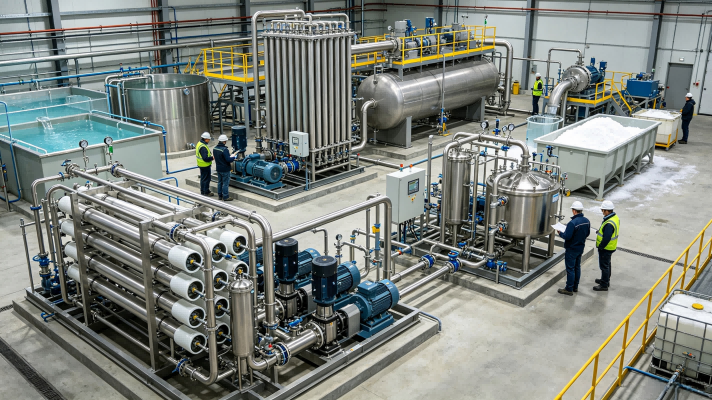
Brine concentration technologies are designed to remove additional water from the RO concentrate.
Depending on the project, additional RO stages, membrane-based concentration, electrodialysis, thermal concentration, or other processes may be considered.
The selection depends on the composition of the brine and the target concentration.
Additional membrane treatment may be attractive when the brine chemistry remains within the operating range of the selected membrane process.
However, as salinity increases, osmotic pressure also increases. This limits how far conventional RO can economically concentrate the stream.
At higher concentrations, thermal or crystallization-based technologies may become part of the treatment train.
Zero Liquid Discharge, commonly abbreviated as ZLD, is a water treatment approach designed to recover water while minimizing or eliminating liquid waste discharge from the treatment system.
A typical ZLD process may combine several technologies rather than relying on a single piece of equipment.
A simplified flow path can be:
RO Concentrate → Brine Concentration → Evaporation → Crystallization → Water Recovery + Solid Residue
The exact configuration varies according to feedwater chemistry and project requirements.
The main objective is to convert a liquid waste stream into recovered water and a concentrated solid or semi-solid residue that can be handled separately.
ZLD provides a very different treatment objective from conventional discharge.
A marine outfall focuses on controlled release of concentrate.
ZLD focuses on recovering water and minimizing liquid discharge.
This requires significantly more equipment and process control.
A ZLD system may include:
Feed equalization
Pretreatment
RO concentration
Brine concentrator
Evaporator
Crystallizer
Condensate recovery
Solid separation
Sludge or salt handling
Thermal equipment can also require substantial energy, especially when large volumes of concentrate need to be evaporated.
Therefore, ZLD should be selected because the project's water-management requirements justify the additional process complexity, rather than simply assuming that it is suitable for every desalination plant.
ZLD can be considered in situations where liquid discharge is difficult or undesirable.
Potential applications include:
Inland desalination
Industrial wastewater treatment
Power plants
Chemical manufacturing
Mining
Metal processing
Pharmaceutical production
High-salinity wastewater treatment
Sites with strict liquid-discharge restrictions
For inland facilities, the lack of access to a suitable marine outfall can be a major reason to investigate ZLD.
Industrial wastewater can also contain multiple dissolved salts and contaminants that require additional treatment before the final residue can be handled.
Brine contains more than sodium chloride.
Depending on the feedwater source, it may contain magnesium, calcium, potassium, bromide, sulfate, and other dissolved substances.
This creates the possibility of recovering selected minerals from concentrated brine.
The concept is relatively straightforward:
Concentrate the brine → Separate selected compounds → Purify the recovered material
In practice, however, selective mineral recovery can be technically challenging.
Different ions remain together in solution and interact with one another. Their concentration changes throughout the concentration process.
The recovery process must therefore consider solubility, precipitation behavior, impurities, chemical consumption, separation efficiency, and product quality.
Sodium chloride is one of the most abundant dissolved salts in seawater.
When brine is concentrated sufficiently, sodium chloride can precipitate and form solid salt.
However, simply producing salt crystals does not automatically create a commercially useful product.
The final material may contain other salts, moisture, organic impurities, or process contaminants.
If the recovered salt is intended for a specific industrial application, additional washing, separation, drying, or purification may be required.
The economics depend on local market conditions and the cost of the recovery process.
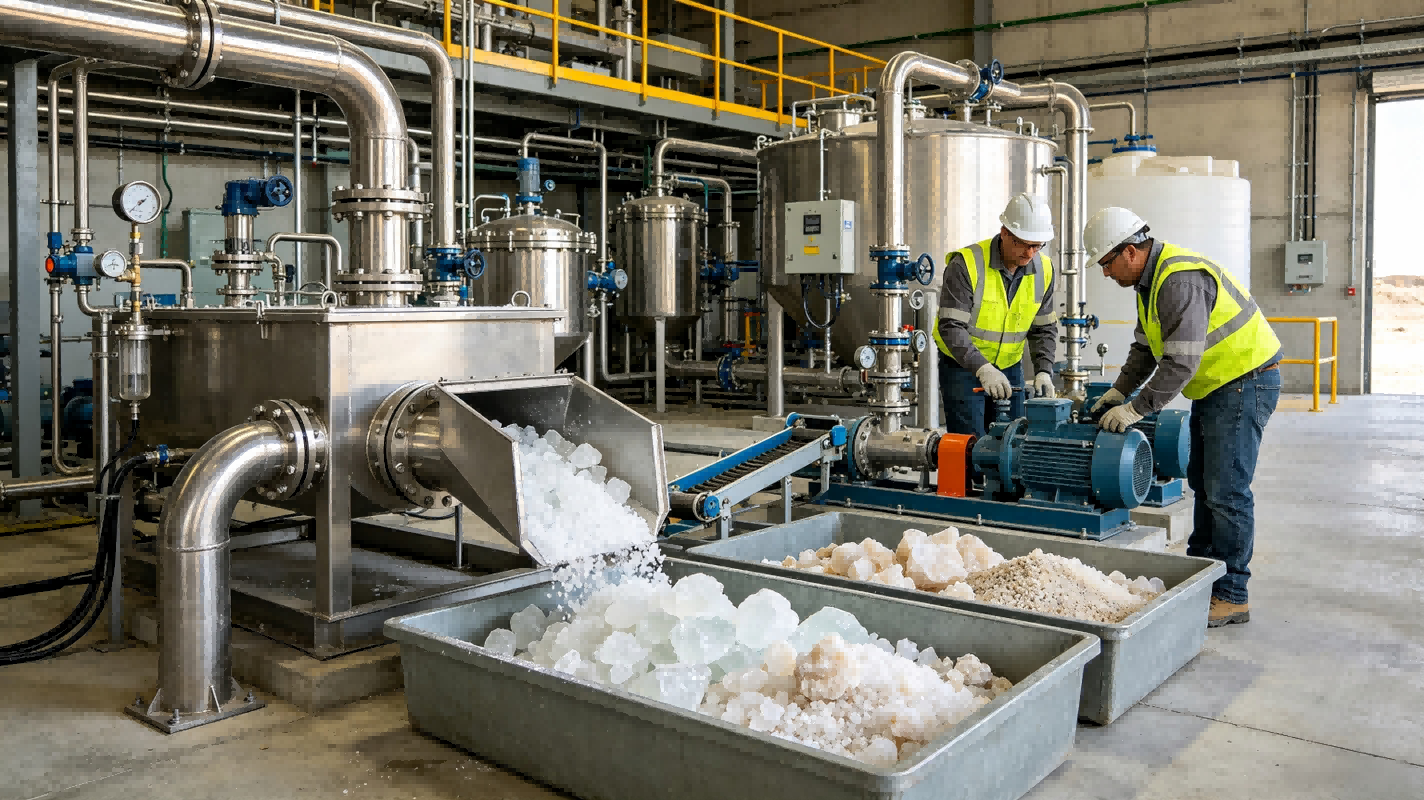
Magnesium is another element present in seawater at meaningful concentrations.
It can potentially be recovered through controlled precipitation or other separation processes.
A typical concept may involve adjusting chemical conditions to convert dissolved magnesium into a solid compound that can then be separated.
The actual process depends on the desired product.
Magnesium hydroxide, magnesium compounds, and other products may require different treatment and purification steps.
The challenge is not simply obtaining a magnesium-containing solid but controlling impurities and achieving a product specification that has practical value.
Calcium compounds can also precipitate during brine concentration.
However, uncontrolled calcium precipitation can create scaling inside equipment.
This illustrates an important distinction between mineral recovery and conventional desalination operation.
In an SWRO system, precipitation is generally something engineers try to prevent because it can damage membrane performance.
In a mineral recovery process, controlled precipitation may instead be the desired outcome.
The difference lies in where, when, and how precipitation occurs.
Brine management and scaling control are closely related.
As water is removed from seawater, dissolved ions become more concentrated.
When a salt reaches its saturation limit, crystals may begin to form.
For an SWRO system, this can cause:
Membrane scaling
Reduced permeate flow
Increased pressure requirements
Increased differential pressure
Cleaning requirements
For a mineral recovery system, controlled crystallization can be useful.
The engineering challenge is to move precipitation from unwanted locations such as RO membrane channels and heat-transfer surfaces into dedicated crystallization equipment where solids can be collected.
ZLD and mineral recovery are not necessarily separate concepts.
A well-designed system can use concentration and crystallization stages to recover water while selectively separating valuable components.
A potential process may look like:
SWRO → Concentrate → Brine Concentration → Selective Recovery → Evaporation → Crystallization → Solid Separation
Not every project needs every stage.
The final configuration should depend on the composition of the feedwater and the desired products.
For example, a project may only need additional water recovery, while another may have a strong reason to recover specific mineral compounds.
Energy consumption is one of the most important factors when comparing brine management options.
Conventional SWRO already requires significant electrical energy because seawater must be pressurized above its osmotic pressure.
Additional concentration increases the treatment burden.
Thermal evaporation generally requires substantially more energy than membrane-based water separation because phase change is involved.
Energy recovery devices can improve the overall efficiency of SWRO systems, but they cannot eliminate the energy required for downstream thermal concentration.
For ZLD projects, engineers should therefore evaluate:
Feed flow
Brine flow
Required recovery
Brine salinity
Thermal energy availability
Electricity cost
Heat integration opportunities
Equipment efficiency
A technically possible ZLD process may not be economically attractive if the energy requirement is too high.
As recovery increases, the concentration of dissolved substances increases.
This can make scaling, fouling, and corrosion control more challenging.
Pretreatment therefore remains important even when the system moves beyond the primary SWRO stage.
Depending on the water source and process configuration, pretreatment may include:
Screening
Media filtration
Ultrafiltration
Cartridge filtration
Chemical dosing
Antiscalant dosing
pH adjustment
The exact treatment train should be determined by feedwater quality and process requirements.
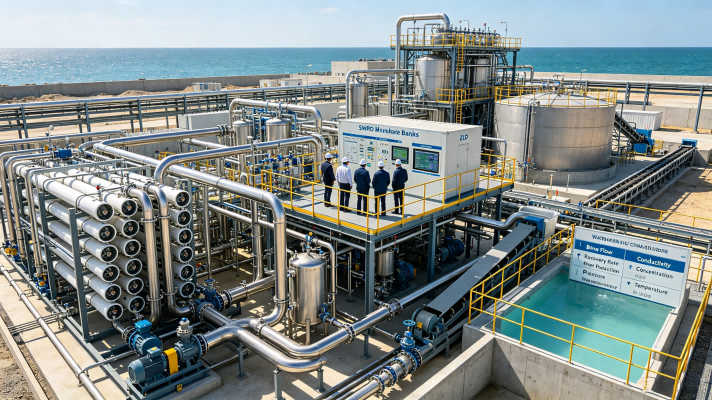
Highly concentrated brine can create a demanding environment for equipment materials.
As salt concentration increases, corrosion resistance becomes increasingly important for wetted components.
Material selection should consider:
Chloride concentration
Temperature
Pressure
Flow velocity
Chemical exposure
Concentration cycles
Cleaning requirements
Depending on the application, duplex stainless steels, super duplex stainless steels, titanium, FRP, specialized polymers, and other corrosion-resistant materials may be considered.
Material selection should always be based on actual process conditions rather than assuming that one material is suitable for the entire plant.
A ZLD system does not make dissolved material disappear.
It changes the form of the waste stream.
After water is recovered, salts and other non-volatile components become concentrated and eventually form a solid or highly concentrated residue.
This material still needs to be collected, stored, transported, reused, or disposed of appropriately.
The characteristics of the residue depend on the original feedwater.
If the feed contains industrial contaminants, the resulting solids may require specialized handling.
Therefore, solid management is an important part of ZLD design.
No.
Mineral recovery should be evaluated from both technical and commercial perspectives.
A recovered material may have limited market value if:
Purity is insufficient
Production volume is too small
Processing costs are high
Transportation costs are significant
Market demand is limited
Additional purification is required
A recovery process should therefore have a clear target product and quality specification.
The economic value of recovered minerals should be compared with the cost of concentration, separation, purification, drying, storage, and transportation.
The appropriate brine management method depends on the project.
A coastal SWRO plant with a suitable receiving environment may use a controlled marine outfall.
A project with tighter discharge constraints may require additional concentrate treatment.
An inland facility may investigate brine concentration and ZLD.
A project with high-value mineral streams may investigate resource recovery.
The decision should consider:
Salinity, hardness, sulfate, silica, organics, metals, and other dissolved components affect the treatment process.
Large facilities generate substantial volumes of concentrate, making energy and equipment sizing important.
The required water recovery determines how far the concentrate must be treated.
Coastal access, land availability, climate, electricity, steam, and wastewater infrastructure can all influence the choice.
Discharge requirements and environmental conditions need to be incorporated into the design from the beginning.
Capital investment, energy consumption, chemical use, maintenance, and residue disposal all affect the total cost.
A practical brine management system should be designed together with the desalination process.
Instead of considering brine only after the SWRO equipment has been selected, engineers can evaluate the entire water and salt balance.
A simplified system may include:
Seawater Intake → Pretreatment → SWRO → Permeate Treatment → Product Water
and
SWRO Concentrate → Brine Management → Discharge / Further Concentration / ZLD / Resource Recovery
This approach allows the designer to evaluate recovery, concentrate flow, chemical loading, energy demand, and final residue at the same time.
For customized Seawater Desalination Equipment, this integrated approach can also help determine the required pumps, tanks, piping, valves, membranes, evaporators, crystallizers, and control instruments.
Brine management systems require reliable process monitoring.
Important parameters can include:
Feed flow
Concentrate flow
Feed pressure
Concentrate pressure
Conductivity
Temperature
pH
Recovery
Total dissolved solids
Chemical dosing
Evaporator operating conditions
Crystallizer performance
Monitoring helps operators identify changes in concentration, scaling tendency, equipment performance, and water recovery.
For complex ZLD systems, automated control can also coordinate multiple treatment stages.
Brine is an unavoidable product of many desalination processes, but its management does not have to follow a single approach.
Conventional marine discharge can be suitable for some coastal projects when the site and regulatory conditions allow it. Other projects may require additional concentration or ZLD because of discharge limitations, inland locations, or higher water recovery requirements.
Mineral recovery introduces another possibility: treating concentrated brine as a potential source of useful salts and minerals.
However, higher recovery and resource recovery also introduce greater process complexity, energy requirements, scaling risks, corrosion challenges, and residue management requirements.
For seawater Desalination Equipment, the most appropriate brine strategy should therefore be selected according to the actual feedwater, plant capacity, recovery target, site conditions, discharge requirements, energy availability, and economic objectives.
A well-designed system treats desalination and brine management as connected processes. By considering water recovery, concentrate handling, material selection, energy consumption, and potential resource recovery together, engineers can develop a treatment system that is better matched to the practical requirements of the project.
Kukiler teswirnamasy
 English
 Portugues
 Pусский
 Français
 العربية
 ไทย
ไทย Indonesia
 Melayu
 Tiếng Việt
 中文
中文 қазақ
қазақ עִברִית
 မြန်မာ
 ພາສາລາວ
 Filipino
 o'zbek
 Кыргызча
 тоҷикӣ
 ខ្មែរ
ខ្មែរ



 Telefon
Teswir
(0)